
GAS REGULATOR
Field Answers No. 01 — Adjusting the Gas on the SOT CAR816 & Enhanced CAR816E
Three states, one lock, no tools. Name the condition, not a number.
// The Short Answer
Clear the rifle. Press the lock. Rotate the regulator to the state that matches what you are shooting. Feel it seat.
The CAR816 is a short-stroke push-rod piston rifle, so its gas adjustment lives at the front of the gas block — outboard of the handguard, reachable without disassembly, moved by depressing a spring-loaded lock and rotating the regulator to the next detent. The mechanism is the easy part. The part worth getting right is that these are not twelve fine increments of a tune; they are three named operating states. Standard is where the rifle lives. Suppressed is where it goes when a can goes on. Adverse is a state you enter deliberately, for a stated reason, and leave again when the reason is gone. Treating Adverse as a permanent setting is the single most common way this system gets misused, and it is the one that costs you parts.
// Before You Touch It
Clear the rifle. Every time.
Remove the magazine, lock the bolt to the rear, and confirm the chamber is empty by eye and by finger before adjusting the gas — including between strings on the range. The regulator also sits directly on the barrel and will be hot after firing. Let it cool or use a glove. Heat is the reason most regulators get adjusted badly rather than deliberately.
// Three States. Each One Has A Job.
The regulator decides how much gas is allowed to act on the piston. That is the whole adjustment.
Caracal specifies the CAR816 gas valve as three positions covering normal operation, adverse conditions, and suppressed fire. Rotating the regulator changes which internal port is aligned with the gas path, which changes how much propellant gas reaches the piston head before the rest is vented at the block. More gas drives the operating rod harder; less gas drives it softer. Nothing else about the rifle changes.
Note what it does not touch: the gas port in the barrel. Port size and gas length are fixed at manufacture. The regulator only decides how much of that gas gets used, which is why it can always take gas away and can never add any beyond what the port already provides.
One point before the table. The regulator carries no numbered scale, so the state is read off the aperture at its front face rather than off a printed position. The photographs further down show all three on a rifle as we ship it. Other CAR816 generations and configurations may present differently, so confirm against the manual that came with your rifle rather than against another rifle or another article. Know which state you are in before you load.
| The system | Specification |
|---|---|
| Settings | 3 detented positions — named states, not a tuning range |
| Standard | Unsuppressed fire, in-spec 5.56 NATO or .223, serviceable rifle. Nominal gas. The default. |
| Adverse | TEMPORARY — heavy fouling, low-impulse ammunition, extreme cold. More gas. Return to Standard when the condition ends. |
| Suppressed | A can is mounted. Less gas — offsets the backpressure a suppressor adds and keeps cycling near normal. |
| Location | Front of the gas block, outboard of the handguard |
| Adjustment | Tool-free, by hand — depress the lock, rotate, release |
| Feedback | Spring-loaded lock and detent — felt and heard as it captures |
| Identification | No numbered scale — read the aperture at the front face. See the photo plate below |
| On your record | The as-shipped state, and the ammunition it was function-checked with |
| What it is not | Not an accuracy feature — see Q 12 |
// What Each State Looks Like
The regulator isn’t numbered. You read it by what the front face shows you.
This is the regulator on a Second of Ten CAR816, photographed in each of its three states plus the detent adjustment button you press to move between them. There is no dial and no printed scale — the state is identified by the aperture presented at the front face of the regulator, which is why this page names states rather than numbers and why it’s worth learning what yours looks like before you need to change it in poor light.
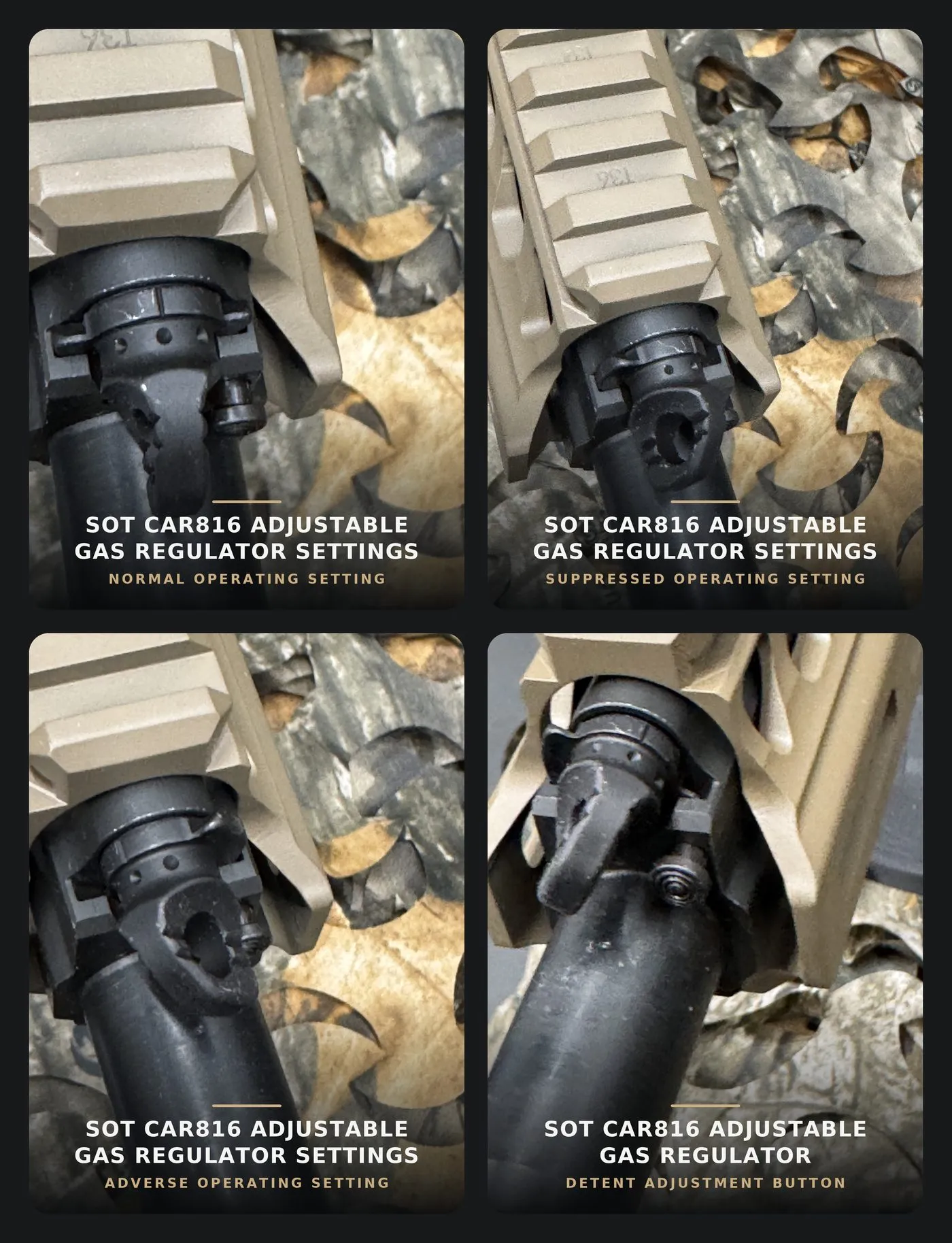
- Top leftNormal operating setting
- Top rightSuppressed operating setting
- Bottom leftAdverse operating setting
- Bottom rightDetent adjustment button
// Questions We Get Asked
What is the actual sequence of steps?
Five, in order, every single time — including the ones that feel unnecessary:
- Clear the rifle. Magazine out, bolt locked to the rear, chamber checked by eye and by finger.
- Check the temperature. The regulator sits on the barrel. Cool enough to handle, or use a glove.
- Depress the lock. Spring-loaded, at the regulator.
- Rotate to the state you want. Not between states — to one of them.
- Confirm the detent captures. Release the lock, then give the regulator a light nudge. If it moves, it isn’t seated.
Do I need tools, or to pull the handguard?
Neither, by design — that accessibility is a large part of why this architecture gets specified. Regulators can be stiff, though, from carbon, cold, or a rifle that hasn’t been cycled much. A blunt non-marring tool such as a nylon punch gives you leverage without gouging the finish. Never use a screwdriver on the detent, and never use a live cartridge as a tool.
Mine is stiff and won’t rotate. Is something wrong?
Usually it’s carbon. The regulator sits in the hottest, dirtiest place on the rifle and the residue there is baked on rather than wet, so a stiff regulator is a maintenance indication before it’s a fault indication. Strip and clean the piston, rod and regulator per the manual and try again. If it’s still seized after cleaning, stop — don’t lever on it. Send it to us or to a qualified armorer.
Which state should it live on?
Standard, unsuppressed. That is what the rifle was tuned around and it’s the right answer for the overwhelming majority of shooting most owners do. Move to Suppressed when the can goes on and back to Standard when it comes off. Move to Adverse only for cause — and move back.
How do I know which state it’s currently in?
You look at it. There is no numbered scale to read, so the state is identified by the aperture presented at the front face of the regulator — compare what you see against the photo plate above. What you don’t do is count clicks from memory or assume it’s where you left it: a rifle that’s been cleaned, transported, handed to someone else, or stripped for a piston clean can come back on a different state than it went out on. Check it as part of your pre-range check, in the same breath as confirming the optic is torqued.
When is Adverse the right answer?
When the rifle is short-stroking and you need it to run now — failures to lock back, failures to fully extract, a bolt that isn’t making it far enough rearward. The usual causes are heavy fouling from sustained fire without maintenance, underpowered or low-impulse ammunition, and severe cold. Adverse is how you finish the string or finish the mission. It is not how you avoid cleaning the rifle.
What happens if I just leave it on Adverse?
The rifle keeps running, which is exactly why people leave it there. What you won’t see immediately is the bill: a faster, harder cycle, higher carrier velocity, more violent extraction and ejection, more felt recoil, and more energy into the buffer, springs, extractor and bolt lugs on every round. Overgassing rarely announces itself with a stoppage. It announces itself with a parts life shorter than it should have been.
Do I have to use Suppressed when I mount a can?
The rifle will generally still function on Standard with a suppressor mounted — but it will be running overgassed, and you inherit the whole suppressed-and-overgassed package: more gas to the face, more fouling driven into the action, harsher cycling, accelerated wear. The state exists precisely because a can changes the pressure the gas port sees. Use it.
How do I verify a state is correct rather than just assuming it?
On the rifle, with the ammunition you actually intend to use, at the range — not on the bench. Work in this order, muzzle downrange throughout:
- Single round, on the magazine. Load one round into the magazine, insert it, chamber and fire. The bolt should lock back on the empty magazine. That’s your baseline functional test.
- Then a short string. Confirm it locks back on the last round every time, not just once.
- Read the ejection. Brass flung violently forward suggests overgassing; brass dribbling out at your feet or failing to clear the port suggests undergassing. Directional indicator, not a measurement — extractor tension, ammunition and buffer weight all move it too.
- Change one variable at a time. Change the state, the ammunition and the suppressor in one session and you’ve learned nothing about any of them.
- Write it down. State, ammunition, suppressor, temperature.
Does the SOT enhancement package change any of this?
No. The Enhanced CAR816E package addresses the load path and service life of the bolt group and the furniture around it — the HM Defense HMB™ complete bolt with arrow-indexed radiused cam pin, the caliber-marked ejection port cover, the Faxon MuzzLok®, optional Cerakote®. None of those parts sits in the gas path or touches the regulator. Procedure, states and verification are identical on an enhanced upper and a standard one.
Can the regulator fix a rifle that won’t cycle?
Only if gas is genuinely the problem. A weak extractor spring, a tired action spring, a cracked bolt lug or a damaged operating rod all present as cycling faults, and turning the gas up will mask any of them for a while. That is the trap. Diagnose first, then adjust — a rifle that only runs on Adverse is telling you something, and it usually isn’t about gas.
Will changing the state change my group size?
Not mechanically, and we won’t claim it does. The bullet has left the barrel before the operating system has meaningfully moved. What the state governs is cycling behaviour, felt impulse and wear. What it can change is your consistency across a long string — a rifle that isn’t beating you up is one you shoot better. That’s a shooter effect, not a barrel claim.
How often does the regulator itself need attention?
Whenever you clean the piston and operating rod — which on a piston gun is the maintenance that actually matters. The piston assembly comes out from the front for routine cleaning without tools.
- Clean carbon off rather than letting it accumulate. The point at which a regulator seizes is well past the point at which it started building up.
- Cycle the regulator through its states during cleaning so it doesn’t set up in one position.
- Go light on lubricant at the gas block. It’s a low-lubrication zone; heavy oil there collects carbon. Follow the guidance in your manual.
- Inspect the piston and rod while you’re in there. Wear on those parts shows up as a cycling problem you’d otherwise be tempted to solve with gas.
// What This Adjustment Does Not Do
It selects between three states well. It is not a tune-up in a knob.
- It restricts; it cannot add. Port size and gas length are fixed at manufacture. The regulator meters what the port already provides.
- It doesn’t compensate for a broken or worn part. Diagnose before you adjust. See Q 11.
- It is not a fine-tuning range. Three named states, not twelve numbered positions. If you need granular gas tuning, that’s a different gas system on a different rifle.
- Adverse is not a setting. It’s a temporary state with a reason attached, and when the reason ends so does the state. See Q 07.
- It doesn’t replace cleaning the piston system. The regulator compensates for conditions, not for neglect.
- It won’t shrink your groups. See Q 12. Reduced disturbance helps the shooter, not the barrel.
- This sheet is not your manual. Marking and numbering vary by generation and configuration, and the manufacturer’s manual for your specific rifle is the controlling document. Nothing here is legal advice regarding suppressor ownership or use.
// What You Get
Every SOT CAR816 and Enhanced CAR816E leaves here with its gas regulator verified against a live function check — and the as-shipped state noted on your build record alongside the ammunition it was checked with. That gives you a known-good starting point to return to no matter what you change in between. If you change it, write down what you changed it to and why. A gas setting you can’t write down isn’t a setting.
Not a black rifle upgrade. A correction.
SOT-FA-001//Rev B//Issued 01 AUG 2026//Field Answers No. 01