
PLUNGER SELECTION
RECC·E Technical FAQ — How the RIFLESPEED Adjustment Range Is Placed
The knob sets the gas. The plunger sets where your headroom lives. One picks a setting. The other picks which direction you can still move.
// The Short Answer
The knob chooses a setting inside a range. The plunger chooses where that range sits.
A RIFLESPEED Gas Control gives you twelve numbered, tactile settings. What most shooters miss is that those twelve numbers are not fixed against the rifle — they are a window, and the plunger decides where the window lands. The plunger is a solid steel pin whose length determines how much the metering geometry closes down at every position on the dial. Swap it, and every one of your twelve settings shifts together.
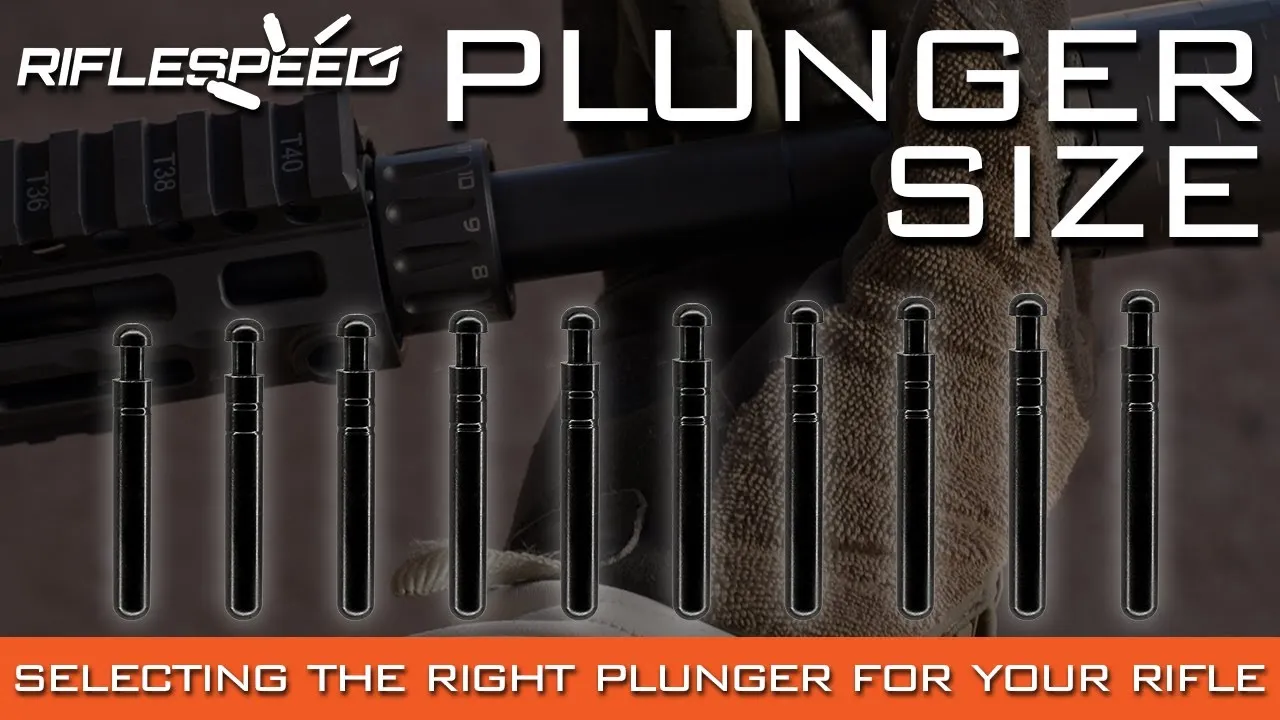
RIFLESPEED offers ten plunger sizes, sequentially numbered, and the number is the length. One size step is worth roughly two positions on the Control Knob. Fit a longer plunger and it meters less gas at every position, so the setting your rifle actually runs on climbs up the dial — leaving the unused range below it, all the way down toward gas cutoff. Fit a shorter plunger and the working setting drops down the dial — leaving the unused range above it, held in reserve.
That is the whole decision, and it is a real one, because you cannot have headroom in both directions at once. Twelve settings is twelve settings. Choosing the plunger is choosing which way your spare adjustment points. A duty carbine that may see a cold morning or a weak lot of commercial ammunition wants reserve above its working setting. A suppressed hunting rifle that may need to choke gas down to bolt-action quiet wants range below it.
// Before You Touch It
Clear the rifle. Every time.
Remove the magazine, lock the bolt to the rear, and confirm the chamber is empty by eye and by finger before touching the Gas Control — including between strings while you are establishing a setting. The Gas Control sits directly on the barrel and will be hot after firing. Let it cool or use a glove. And never dial below the Rotation Stop: it crushes the wave spring, and the damage does not show up until later, as inadequate spring pressure at the top of the range.
// What The Plunger Is, And What It Does
A solid steel pin whose length decides how much gas every setting is allowed to pass.
The plunger rides in the Gas Control body and meters flow from the barrel port to the gas tube. It is smooth — no threads to foul with carbon — and it carries rotation indicator grooves near the working end that tell you which Rotation Range the knob is in. Because the plunger lives in the body rather than in the barrel, changing it is a component swap, not a barrel operation.
Every RIFLESPEED Gas Control leaves the factory with plunger #917 installed, which is a sound general-purpose choice across most cartridges and configurations, plus a spare in the box. Second of Ten does not leave it at the factory default on our 6mm precision rifles. The 6mm MAX and 6mm ARC precision uppers are built with the #887 — one size shorter than the RIFLESPEED default, and the size RIFLESPEED themselves recommend for the 6mm cartridges. It is the configuration we tune and record against.
| The system | Specification |
|---|---|
| Plunger sizes offered | Ten, sequentially numbered |
| What the number means | Plunger length — not a gas volume or a caliber code |
| Value of one size step | ≈ 2 Control Knob positions |
| Installed from factory | #917 |
| SOT 6mm precision spec | #887 — 6mm MAX and 6mm ARC, per RIFLESPEED’s 6mm guidance |
| Included spare | #887 (was #937 prior to June 2023) |
| Control Knob settings | 1–12, tactile click per setting |
| Rotation ranges | Two — all published settings reference Range one |
| Range identification | Dial to 6 — one groove is Range one, two grooves is Range two |
| Longer plunger | Less gas per position — working setting moves UP |
| Shorter plunger | More gas per position — working setting moves DOWN |
| Service life | 10,000–25,000 rounds, firing schedule dependent |
| Never do this | Dial below the Rotation Stop — it crushes the wave spring |
// Watch It Explained
Why the plunger is chosen, and how the choice is made.
RIFLESPEED’s own walkthrough of plunger selection — the reasoning behind the sizes and the process for arriving at one. Worth watching before you order a different plunger, and worth watching again before you fit it.
 Watch on YouTube
“Plunger Selection for your Riflespeed Gas Control.” Opens on YouTube in a new tab. Second of Ten is a customer of RifleSpeed LLC, not a spokesman — where this video and our sheet differ, follow the manufacturer’s current published instructions. https://youtu.be/U4HyyAOiqPw
// Questions We Get Asked
So how does plunger selection actually work?
Mechanically it is simple. The plunger is the part that restricts flow between the barrel port and the gas tube, and how much it restricts at any given knob position is a function of its length. A longer plunger sits further into the gas path at every one of the twelve positions, so every position meters less. A shorter one meters more. The knob has not changed; the whole scale it is riding on has moved. The decision runs like this:
- Find your working setting. The setting at which your rifle reliably locks the bolt back on an empty magazine, in the ammunition and conditions you actually use.
- Look at where it sits. Low on the dial, in the middle, or high?
- Decide which way your spare adjustment should point. Toward more gas, or toward less. You do not get both.
- Change the plunger only if it is in the wrong part of the dial. One size step is worth about two positions, so the arithmetic is straightforward.
What does the plunger number mean?
The length. RIFLESPEED numbers the ten sizes sequentially, and a higher number is a physically longer plunger. It is not a gas volume, a caliber code or a percentage — it is a dimension, which is why the relationship between the number and the behavior is so predictable.
Which plunger is in my rifle?
Depends on the build, and your build record states it either way.
- 6mm MAX and 6mm ARC precision rifles: #887. That is our spec, fitted and tuned here — one size shorter than the RIFLESPEED factory default.
- Other builds carrying a Gas Control: #917 unless the record says otherwise.
- For reference, the RIFLESPEED retail package ships #917 installed with a spare, currently #887; before June 2023 that spare was #937.
Longer or shorter — which way does the working setting move?
This is the one thing shooters get backwards, so it is worth stating plainly and then again with numbers. A longer plunger meters less gas, so you have to dial higher to get the same cycling — your working setting moves UP. A shorter plunger meters more gas, so you dial lower — your working setting moves DOWN. RIFLESPEED’s own worked examples:
- A 5.56 carbine on plunger #937 locks back at setting 5 suppressed and setting 8 unsuppressed. Drop to the shorter #917 and those become roughly 1–2 and 4–5 — which leaves settings 6 through 12 available to add gas when temperatures fall or a weak lot turns up.
- A suppressed .300 BLK hunting carbine on #937 locks back at setting 4 on supersonic. Move to the longer #979 and that becomes 11–12 — which puts setting 1 far enough down that gas is choked to a single shot, letting subsonic loads run as quietly as a bolt gun.
- Same rifle, same knob, same twelve numbers. Only the placement of the range changed.
How do I tell which Rotation Range I am in?
Dial the Control Knob to setting 6 and look at the rotation indicator grooves on the plunger. One groove visible means Rotation Range one. Two grooves means Rotation Range two. Every setting published by RIFLESPEED, and every setting on your build record, references Range one.
What if my rifle needs Rotation Range two?
Then it needs a different plunger. RIFLESPEED’s instruction on this is explicit: if your firearm requires settings in the second Rotation Range, fit a shorter plunger rather than running in Range two. The Gas Control is designed to be used in Range one, and keeping every rifle on one common scale is also what makes a written-down setting mean the same thing on every gun in the rack.
Does temperature change which plunger I want?
It changes which direction you want your reserve to point. Cold guns and cold ammunition both need more gas, so if you set the rifle up in temperate weather and expect hard winter use, you want your working setting low with room above it — a shorter plunger. If you tuned it in the cold and expect summer heat, the reverse applies, and a longer plunger keeps room to come down.
Will a plunger change fix an undergassed rifle?
No, and this is the honest ceiling on the whole subject. A plunger repositions the adjustment range. It does not add gas capacity. The barrel’s gas port sets the maximum available, and a Gas Control can only restrict what arrives. If a rifle will not run reliably with the plunger wide open at setting 12, the problem is upstream — port size, gas length, buffer and spring, or ammunition — and no plunger in the set will solve it. Send it back to us.
I run suppressed. What should I be thinking about?
Two different goals, and they want opposite plungers. If you simply want to tame suppressed back pressure while keeping unsuppressed function guaranteed, keep the working settings low and the reserve above them. If you want the ability to shut gas down far enough for subsonic single-shot quiet, you want the working settings high, with the bottom of the dial free to choke. Decide which of those you are actually buying before you order a plunger.
You pin the gas block. Does that lock me out of plunger changes?
No. The plunger lives in the Gas Control body, and the body stays on the barrel — pinning secures the block to the journal, not the plunger to the block. Disassembly in place is possible. It is tedious under an extended handguard, so if you already know you want a different plunger, tell us at build time and we will fit it and record it.
Do larger cartridges need a different plunger?
Often, but not in the direction you would guess, and the 6mm cartridges are the reason to say so carefully. Larger cases such as .308 Winchester and 6.5 Creedmoor generate more gas volume, so RIFLESPEED notes they may call for a longer plunger than a typical 5.56 configuration. For the 6mm cartridges RIFLESPEED recommends the opposite — a shorter plunger, and they name the #887 for 6mm ARC. That is why our 6mm precision rifles are built on it: our specification follows the manufacturer’s own guidance for the cartridge, not a house preference. Case size alone does not decide the answer — barrel length, gas length, port size, buffer weight and ammunition all move it. Always confirm function on your own rifle.
What is the procedure for finding my setting?
On a safe range, with the ammunition you intend to use, in conditions representative of your use:
- Start at setting 6.
- Load a single round, chamber it, and leave the empty magazine seated.
- Fire one shot and check whether the bolt carrier locks to the rear on the empty magazine.
- Adjust two numbers at a time to bracket the minimum setting that locks back reliably.
- For tactical or defensive use, run one setting above that minimum — RIFLESPEED’s recommendation, and ours.
- Never dial below the Rotation Stop. It crushes the wave spring, and the damage shows up later as inadequate spring pressure at settings 9 through 12.
How long does a plunger last?
RIFLESPEED puts service life at 10,000 to 25,000 rounds depending on firing schedule. Replace it when the working end has worn away by about half, or as a matter of course when you replace a worn barrel or bolt. Maintenance is a drop of CLP where the plunger enters the Gas Control body at the end of each firing event, then run the knob to 1, to 12, and back to your setting.
My rifle has a fixed gas block. Why no Gas Control?
Because it is a short barrel, and that is a deliberate choice rather than an omission. Our 10.3″ and 10.5″ pistols and SBRs — the 5.56 builds, the 6mm MAX and the MK18 models — run pinned low-profile fixed gas blocks. A compact gun on carbine-length gas is not the rifle an adjustable block was invented for: you are not chasing a setting across seasons on it, and a correctly sized port with a pinned block is fewer parts, nothing to snag, and nothing to move in a bag. Gas is set once, at manufacture, and verified on our range.
// What Plunger Selection Does Not Do
It places the adjustment range well. It is not a source of gas.
- It is not an accuracy feature. Nothing about plunger length changes how the barrel shoots. It changes how the action is driven, and how much adjustment you have left over.
- It does not add gas. The barrel port sets the ceiling. A plunger only decides how much of what arrives is allowed through at each position. See Q 08.
- It does not give you headroom in both directions. Twelve settings is twelve settings. Moving the range toward one end takes it away from the other. That trade is the decision.
- It does not replace confirming function. Published examples are examples. Cartridge, barrel length, gas length, port size, buffer, spring, suppressor, ammunition and temperature all move the answer — confirm on your rifle. See Q 12.
- It is not a substitute for the Rotation Stop. Reaching a needed setting by dialing past the stop damages the wave spring. If you need Range two settings, you need a shorter plunger. See Q 06.
- It does not apply to every build. Short-barrel pistols and SBRs run fixed gas blocks by design. See Q 14.
- This sheet is not your manual. RIFLESPEED’s current published instructions are the controlling document for their component. Where this page and their material differ, follow theirs.
// What You Get
Every Second of Ten rifle fitted with a RIFLESPEED Gas Control leaves here with both the plunger number and the setting number written on the build record — alongside the ammunition and the conditions under which they were established. On our 6mm MAX and 6mm ARC precision rifles that plunger is the #887, fitted and tuned here rather than left at the factory default. A setting is only a setting if you know what it was measured against. That is also why we pin the Gas Control body with a stainless coiled spring pin as well as torquing the set screws: a recorded number means nothing if the block can creep underneath it.
The knob is what you turn. The plunger is what you decide.